Wednesday, November 22, 2017

Moving Forward

    When I think about the way I learned I remember there was only one way to do it.  There wasn’t a choice and the lessons were not customized to suit my learning style.  For example, in math class, I remember my teacher placing these big, red, x marks on my paper because I couldn’t arrive at the correct answer.  I struggled with mastering the algorithm to subtract in third grade. 


      Once I finally mastered the steps I never really understood what was actually taking place until I became a teacher of mathematics.  Fast forward to today, children are given multiple ways to solve subtraction in order to be successful.  Number lines, place value, base-ten blocks, and the infamous algorithm are tools that students have the option to use.  Today’s education learning is personalized for students by giving them the tools they need but should it stop there?  Shouldn’t we continue to develop a more personalized learning environment?  “Our students want to be creative and collaborate, utilize technology for learning, connect with their peers in other countries, understand the messages that media convey, and solve real-world problems” (Sheninger, 2016) 

     Think about it for a moment…personalization exists everywhere.  Facebook is customized to suit our interests and needs.  Have you ever seen sponsored ads pop up on your feed?  Most of the time these are items we have searched for on Amazon or something that you have liked in the past.  We can also create groups that feed our passions and inspire us.  It’s collaboration, education, and personalized learning.  Have you ever been on Pinterest?  Pinterest also customizes interests based on the boards you have pinned.  When I go to my Pinterest feed I am surrounded by products and lots of teacher ideas that I don’t have to search for.  To be honest my Pinterest boards are mostly made up of teacher “stuff” because I’ve pinned thousands of teacher-related items.  This is how Pinterest has personalized my learning experience. 


    Sir Ken Robinson explains that education doesn’t need a reform because that requires us fixing it.  Education is not broken but education needs a revolution” (Robinson, 2010).  Imagine what it would be like if students were excited about to school. I have really tried to make this a reality in my classroom.  I’ve changed the space, adapted new ideas, changed my mindset about how instruction should be delivered, and created personalized learning experiences for my kids. Quite frankly I am obsessed with revolutionizing my classroom for my kids because they deserve it!  “You have the same choice every day.  You can choose what’s always been done-the safe and easy. Or, you can choose what’s less simple, potentially more difficult, and absolutely more rewarding” (Neslonely and Welcome”).


Frost, R. (n.d.). The Road Not Taken by Robert Frost. Retrieved November 22, 2017, from    https://www.poetryfoundation.org/poems/44272/the-road-not-taken

Kieschnick, W. (2017). Bold School: Old School Wisdom + New School Technologies.
    NewYork: International Center for Leadership in Education

Nesloney, T., & Welcome, A. (2016). Kids deserve it!: pushing boundaries and challenging conventional thinking. San Diego,   CA: Dave Burgess Consulting, Inc

Robinson, K. (n.d.). Bring on the learning revolution! Retrieved November 22, 2017, from https://www.ted.com/talks/sir_ken_robinson_bring_on_the_revolution

Sheninger, E. C. (2016). Uncommon learning: creating schools that work for kids. Thousand  Oaks, CA: Corwin.


Sunday, November 19, 2017

Scouts Can't Wait!


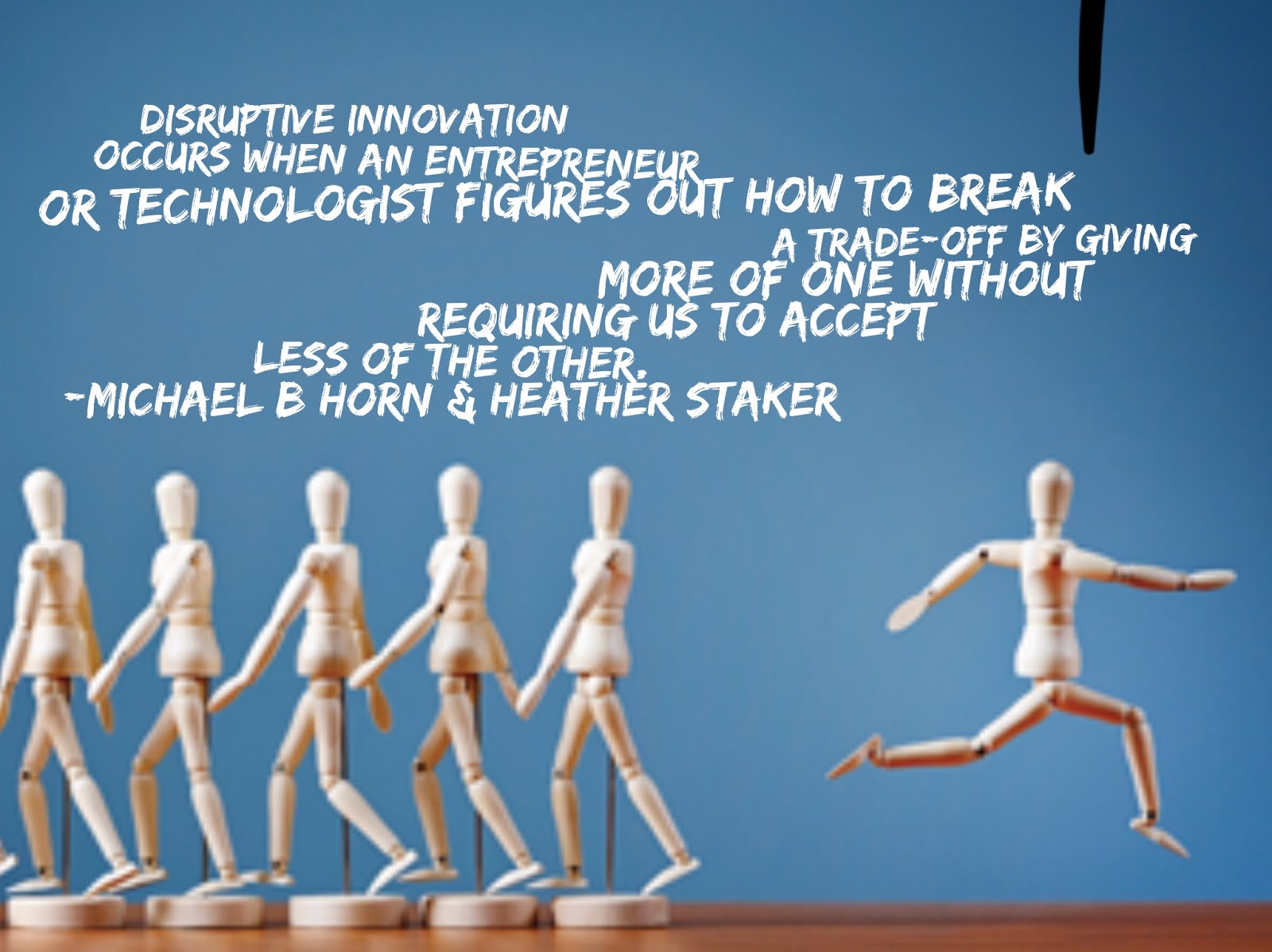
      Disruptive innovation is important because it can be a catalyst for change in education because those willing to take the risk can persuade others to follow.  It comes about by scouts who are willing to explore and collect data in order to lead change in our schools.  It’s not about giving up all of the ways we have taught our students, it’s about how we can customize the students’ needs.  Michael Horn describes how using the blended learning model can personalize learning for our students. Personalized learning gives students a sense of ownership. Students who control their time, place, path, or pace are more likely to fill gaps in their learning because they do not move on until mastery is met. One way to that I allow students to control their pace and place is through Canvas LMS. It enables my classroom to be a blended learning environment through online learning. Canvas lessons are set up for the week and students can work through them at their own pace and place because it’s available to them at home or school. In class, students move through activities using a choice board along with an accountability sheet. I use a combination of the station rotation model and individual model to meet the needs of my students.  Technology should be used because of a content idea and a way for students to showcase their learning with the world. I’m so excited to be reading “Blending” because it confirms some of the things I have already started in my classroom.  Since reading “Blending” I have begun to make even more changes that can help personalize my students learning.


Horn, M. B. (2015). Blended: using disruptive innovation to improve schools. San Francisco, CA:
       Jossey-Bass.


Sunday, October 29, 2017

Our Stories

  Every one of us has a story to tell.  It’s where we have been, where we are, and where we are going. Life creates our stories and for many of us, there are stories still left to be written.  I believe ePortfolios are the best storytellers we can have.  It sets the stage to tell who we are and what we stand for.  You can tell a lot about a person just by viewing their home page.  I’ve looked at several examples and I can feel the hard work and passion each person has put into their ePortfolio.  Our stories should not stall in the creation process, they should be shared.  A story only comes alive once it is read.  I believe sharing our stories with others will give one insight into our passions and what drives who we are. They might also inspire others. Isn’t that what we want to do, inspire others?  “To be a person is to have a story to tell.” – Isak Dinesen


102 of the Most Inspiring Storytelling Quotes of All Time. (2016, May 18). Retrieved         October 29, 2017,  from http://typeacommunications.com/102-of-the-most-                 inspiring-storytelling-quotes-of-all-time/


Monday, October 23, 2017

How can we shift a mindset?

How can we shift a mindset?
    “Is this for a grade?”.  I often hear those words from my students.  How do we shift our students’ mindset into owning their learning?  I believe it’s through the use of  COVA model.  Some of my students have begun creating online portfolios as a way to leave their mark.  They are quite curious and excited to work on their sites; however, they are a little unsure of the freedom to choose their learning paths.  Students need to “acquire technical skills for their digital lives but also engage in work that provides richly teachable moments” (Watters). Creating eportfolios with my students has provided many teachable moments in class. For example, one of my students asked if she could create a screencast that would teach others how to login into Classlink.  As a result, we began to explore screen cast extensions. She researched a few extensions and chose the one she was most comfortable with.  It’s amazing to witness a nine-year-old narrate a video with step by step directions that will help others login.  Another group created a tutorial video explaining what symmetry is.  They asked for directions but I instructed them to choose the method that worked for them.  Who owns the eportfolio?  These students are creating and producing online productions using high, level learning skills that they can take with them outside the classroom.  I believe my students own their eportfolio because they are becoming “effective architects, narrators, curators, and inhabitants of their own learning” (Harapnik). My students are taking ownership of their learning because I have given them the opportunity to make it meaningful to them.  According to Dwayne Harapnuik, “making meaningful connections is what leads to learning.”  This brings me back to the question, how can we shift a mindset? It is really the students that need to shift their mindset about owning their learning or do educators need to shift their mindsets on how students learn?


Harapnuik, D. (n.d.). It's all about learning. Retrieved October 22, 2017, from                                                                         http://www.harapnuik.org/?page_id=6050
Watters, A. (2015, July 15). The Web We Need To Give Students. Retrieved October 22, 2017, from https://brightreads.com/the-web-we-need-to-give-students-311d97713713     


Monday, October 16, 2017

Why Blog?


    Seth Godin describes blogging as a way to “force yourself to explain why you did something by responding out loud.” I started blogging this summer as a way to reflect on my teaching experiences.  I have never been a writer so blogging has been a great way to extract my beliefs and thoughts into words.  My Teaching Blueprint has enabled me to share my thoughts and voice with whomever cares to listen.  This blog was started because I needed a way to express my “Why” for teaching.  Having this blog has helped me recognize that my voice matters and is significant.  I now believe that we must use our voice to reflect and motivate those who happen to read our conversations.  That’s why sharing our ePortfolios with our classmates/peers is such a powerful opportunity for us to grow and learn from each other.  We are not alone in education.  Sharing our experiences through collaboration allows us to receive feedback that can strengthen our appetite to succeed.


I. (2009, April 18). Seth Godin & Tom Peters on blogging. Retrieved October     16, 2017, from   https://www.youtube.com/watch?v=livzJTIWlmY


Saturday, October 14, 2017

Who owns the learning?  Alan November suggests kids want a voice and want to share it globally.  We live in a world where we are globally connected instantly.  Last year I connected with a teacher from India through Skype and it was a classroom, game changer.  We learned about the Indian culture and my kids were fascinated that they were able to connect with students across the globe.  If I own my learning and seek out my passions why shouldn’t my students?  This year I started “Genius Hour”.  “Genius Hour” is a time where students get to investigate (on their own) and share what they are passionate about.  This has generated a lot of excitement with all of my students.  My students are eager to come to school and are producing presentations that they want to share with others.  They own their learning and it is evident because of their engagement, hunger to present, and desire to research through books and online resources.  

T. (2011, March 25). TEDxNYED - Alan November - 03/05/2011. Retrieved October 14, 2017, from    https://www.youtube.com/watch?time_continue=1&v=ebJHzpEy4bE  


Sunday, October 1, 2017

Leave your Mark

Why I Teach!             

     Think about your favorite teacher the one you just can’t forget.  What did they do to be forever placed in your memory?  Was it a special activity that you remember? Was it the way they never gave up on you? Whatever that teacher did to leave their mark, it’s something you will never forget.  This is why I teach! I want to be the teacher that leaves that lasting impression on her students' lives.  I want to be the kind of teacher they remember. I pray that they remember how I truly cared for them and valued their self-worth. I believe developing relationships with my students is the key to leaving my mark.

#leaveyourmark